

.png)
How Live Bank Feeds Cut Closing Time for your Finance Team
Finance teams are being asked to operate in a very different world than the one their processes were designed for. CFOs are no longer judged primarily on how accurately they report the past, but on how quickly and confidently they can explain the present and guide what comes next.
That shift has placed new pressure on one of the most foundational inputs in finance: bank data.
Live bank feeds are becoming a quiet but critical capability for modern finance teams. Not because they are novel, but because they align banking activity with how organizations now expect their financial systems to behave: continuously, reliably, and in near real time. This shift has direct implications for how quickly the books close, how early confidence builds, and how effectively finance supports decision-making across the business.
The modern CFO operates in real time
Over the past several years, the CFO role has expanded well beyond stewardship. Industry research consistently shows that a majority of CFOs now spend more time on strategic planning, scenario analysis, and operational decision support than on traditional reporting alone. Boards and executive teams expect faster answers to more complex questions, often before a period has formally closed.
At the same time, close cycles continue to compress. Five-day closes are increasingly treated as a benchmark rather than an aspiration, and high-performing finance teams are moving toward rolling or continuous close models. The common thread across these organizations is not heroics at month-end, but earlier access to reliable data.
Cash visibility, in particular, has become a priority. In recent CFO surveys, real-time or near-real-time insight into cash position routinely ranks among the top concerns, especially in environments marked by volatility, tighter capital conditions, or rapid growth.
These expectations create a simple tension. Finance leaders are expected to move faster, but many core data flows still operate in batches.
What live bank feeds actually change
Live bank feeds establish a direct, secure connection between banks and the ERP, allowing transactions and balances to flow automatically into the system as activity occurs. Instead of periodic updates, finance teams work with a continuously refreshed view of reality.
This changes the nature of reconciliation. Rather than being a concentrated effort at month-end, reconciliation becomes a routine, ongoing process. Exceptions surface earlier. Context is easier to recall. Corrections are smaller and less disruptive.
From an operational perspective, this matters because timing is often more impactful than volume. Industry benchmarks regularly estimate that 30 to 40 percent of close effort is tied to reconciliation and validation. When that effort is delayed, it stacks. When it is distributed, it becomes manageable.
Live bank feeds also change how finance teams engage with cash management. When balances are current, cash reporting shifts from retrospective to operational.
This matters because cash decisions rarely wait for month-end. CFOs are asked to assess liquidity, evaluate risk, and support investment decisions continuously. When bank data lags, those conversations are qualified, and finance teams are restricted in their ability to make decisions.
Why ERP-integrated bank feeds matter
Modern ERP systems are built on the assumption that financial data flows continuously, not episodically. Cash management, reconciliation, forecasting, and reporting all depend on timely inputs. When bank activity arrives late or in batches, even the most capable ERP is forced into a reactive posture, waiting for updates before it can reflect reality.
ERP-integrated bank feeds address this gap by embedding bank data directly into core financial workflows. Transactions and balances behave like native ERP data rather than external inputs that need to be imported, validated, and reconciled after the fact. This allows finance teams to work from a single, continuously updated source of truth.
The impact becomes more pronounced as complexity increases. Organizations with multiple banks, higher transaction volumes, or multi-entity structures quickly discover that manual or batch-based processes do not scale. Each additional account introduces friction. ERP-integrated bank feeds scale differently, extending connectivity without multiplying effort.
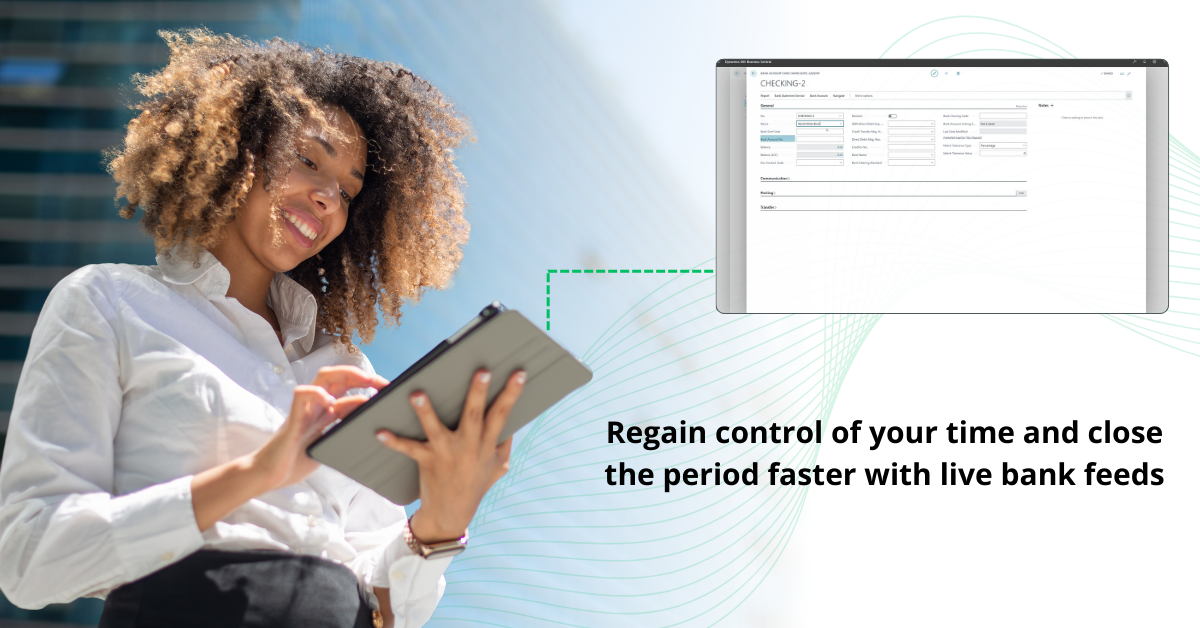
For ERP platforms such as Dynamics 365 Business Central, this integration allows the system to operate as intended. Reconciliation workflows smooth out. Cash visibility improves earlier in the cycle. Reporting aligns more closely with what is actually happening in the business, not what was true several days ago.
Solutions like Yavrio focus on this integration layer, providing secure, direct bank connectivity that fits naturally into ERP environments. The objective is not to introduce another system for finance teams to manage, but to remove friction from one of the most fundamental data flows in financial operations.
Security and control in a live data model
A common misconception is that live bank feeds increase risk. In practice, they often reduce it.
Manual workflows introduce multiple handling points for sensitive data, from downloads to local storage to uploads. Live bank feeds rely on secure, permissioned connections with clear audit trails and access controls. Data moves directly between systems without unnecessary exposure.
From a compliance perspective, this improves traceability. From an operational perspective, it reduces the risk of human error. Both outcomes support the CFO’s mandate to balance speed with control.
Finance teams aspire for more than automation
It is tempting to view live bank feeds as a technical upgrade. In reality, they reflect a broader adaptation in how finance teams operate.
As expectations shift toward continuous insight, finance functions are rethinking where effort is best spent. Manual reconciliation and late data validation are increasingly seen as poor uses of skilled capacity. Automation is not about replacing judgement, but about preserving it for higher-value work.
This shift also supports sustainability. Close periods are a well-documented source of stress and burnout in finance. Reducing last-minute pressure improves not only outcomes, but retention and morale.
A foundation for the next phase of finance
Live bank feeds are not a silver bullet. They will not solve every close challenge or eliminate every exception. What they do provide is a foundation that aligns bank data with the pace of modern business.
For CFOs, it supports a role that is increasingly forward-looking and decision-oriented. The move toward live bank connectivity is not about abandoning old tools for the sake of change. It is about recognising that finance teams now operate in a world where delay has a cost, and where insight is only as good as the data behind it.
Shorter closes are the visible outcome. A finance function that can keep up with the business is the real prize.
